






About ORENCIA® Infusion Therapy
ORENCIA® (abatacept) is a selective T cell costimulation modulator given as an intravenous (IV) infusion. Most of the medicines described on our other infusion pages work by switching the immune system on so it can attack cancer. ORENCIA® does the opposite. It quiets an immune system that has begun attacking your own joints and tissues.
T cells need two signals to switch on. The first identifies a target, and the second gives permission to act. ORENCIA® is a fusion protein built around CTLA-4, your body's own brake on that second signal. It binds to CD80 and CD86 on the cells that present targets to T cells, so the permission signal never arrives and the inflammatory response is calmed before it builds.
A useful contrast. YERVOY® (ipilimumab), described on another of our pages, blocks CTLA-4 in order to release that brake and turn T cells loose on cancer. ORENCIA® supplies a CTLA-4 protein in order to apply the brake. Same checkpoint, opposite direction, because the goal is the reverse.
Adult dosing is weight-tiered rather than calculated. There is no mg/kg arithmetic for adults with rheumatoid arthritis or psoriatic arthritis. You receive 500 mg if you weigh less than 60 kg, 750 mg if you weigh 60 to 100 kg, and 1,000 mg if you weigh more than 100 kg. Each dose is given as a 30-minute infusion at week 0, week 2, and week 4, then once every four weeks after that.
Children with polyarticular juvenile idiopathic arthritis are dosed by weight. Patients 6 years and older who receive the infusion get 10 mg/kg if they weigh less than 75 kg, or the adult weight tiers if they weigh 75 kg or more, up to a maximum of 1,000 mg. The week 0, 2, 4, then monthly schedule is the same. The IV infusion is not approved for children under 6, or for children with psoriatic arthritis. Those patients use the subcutaneous injection instead.
Graft versus host disease prophylaxis follows a completely different schedule. Patients 6 years and older receive 10 mg/kg over 60 minutes on the day before transplant, then on days 5, 14, and 28 afterward. Children aged 2 to under 6 receive 15 mg/kg on the day before transplant, then 12 mg/kg on days 5, 14, and 28. That is four doses in total, always given with a calcineurin inhibitor and methotrexate, rather than an ongoing monthly treatment.
Three things happen before your first dose. You are screened for tuberculosis, and latent TB is treated before ORENCIA® begins. You are screened for viral hepatitis. And your vaccinations are brought up to date, since live vaccines cannot be given once treatment starts. Transplant patients also begin antiviral prophylaxis for Epstein-Barr virus before the first dose, continuing for six months after transplant.
ORENCIA® is not combined with other immune-suppressing biologics. Taking it alongside a TNF antagonist, another biologic DMARD, or a JAK inhibitor raises the risk of serious infection without adding benefit, so those medicines are stopped before ORENCIA® starts. Non-biologic DMARDs such as methotrexate are commonly continued.
There is also a subcutaneous form. ORENCIA® is available as a 125 mg weekly injection in a prefilled syringe or ClickJect™ autoinjector for use at home. This page describes the intravenous infusion given at our centers. Patients switching from the infusion to the injection take the first injection in place of the next scheduled infusion.
Conditions treated by this therapy
ORENCIA® is FDA-approved for people who are:
- Adults living with moderately to severely active rheumatoid arthritis, given on its own or alongside non-biologic disease-modifying drugs such as methotrexate
- Children 6 years and older with moderately to severely active polyarticular juvenile idiopathic arthritis, given on its own or alongside methotrexate
- Adults living with active psoriatic arthritis, with or without non-biologic disease-modifying drugs
- Adults and children 2 years and older receiving a blood stem cell transplant from a matched or single-allele-mismatched unrelated donor, to help prevent acute graft versus host disease, given in combination with a calcineurin inhibitor and methotrexate
A note on who receives the infusion rather than the injection: the intravenous infusion described here is not approved for children with psoriatic arthritis, or for children under 6 with juvenile idiopathic arthritis. Those patients are treated with the subcutaneous injection, which is approved from age 2. A referral for a young child should specify the subcutaneous product.
A note on combination therapy: ORENCIA® is not recommended together with TNF antagonists, other biologic DMARDs, or JAK inhibitors. If you are currently on one of those medicines, your specialist will plan the transition before your first infusion.
Your rheumatologist, or your transplant team if you are receiving ORENCIA® around a stem cell transplant, will confirm whether this therapy is right for you before treatment begins.
ORENCIA® Price
The cost of prescription medications can vary depending on your insurance coverage. If you're concerned about the price of your medication:
- Contact your insurance provider to understand your coverage
- Ask your doctor or pharmacist about lower-cost alternatives
- Check with the drug manufacturer about financial assistance programs
- Explore patient assistance options if you're uninsured or underinsured
Remember, many resources exist to help patients access necessary medications. Don't hesitate to ask for help if you're struggling with medication costs. No patient should go without necessary treatment due to financial limitations. If you have questions about financial assistance opportunities, contact a member of our Violet Health team.

What to Expect During ORENCIA® Infusion Therapy
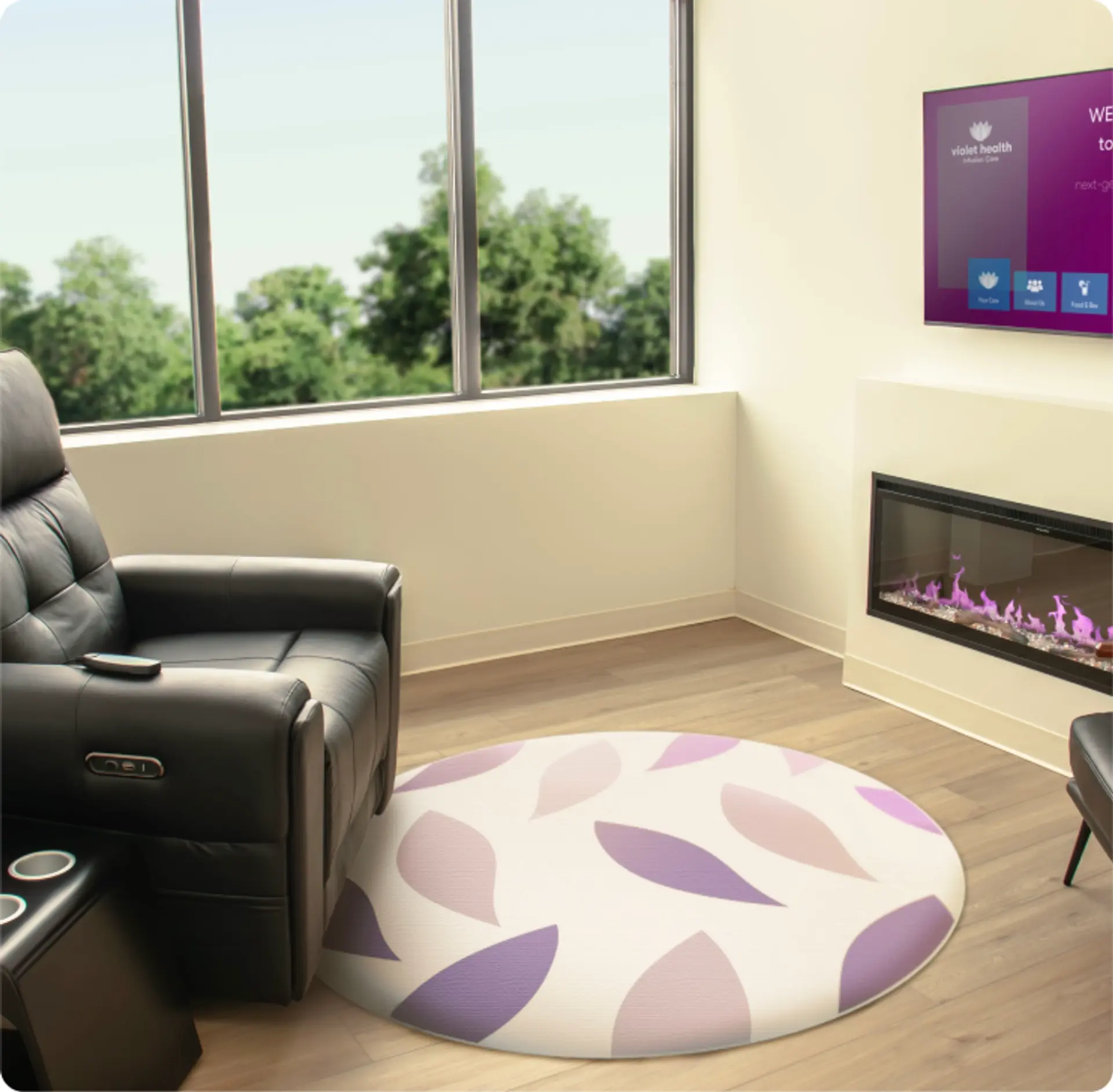
When you arrive at a Violet Health location, our team will greet you by name and help you settle into a private, welcoming space designed for comfort during your infusion. Here is what a typical visit looks like. Your care team will:
- Ask about any signs of infection, including fever, chills, a new or lingering cough, warm or painful skin, or burning with urination, since infection is the main thing we watch for on this treatment
- Check your vital signs and confirm your current weight, since weight determines which dose tier you fall into
- Confirm before your first dose that tuberculosis and viral hepatitis screening are complete and that any latent TB has been treated
- Review your vaccination record and confirm no live vaccine is planned during treatment
- Place your IV using gentle, practiced technique. Routine premedication is not needed for ORENCIA®, which is a real difference from most of the other infusions we give
- Give the infusion over 30 minutes through a line with a low-protein-binding filter
- Stay with you throughout and watch you for a short period afterward, since the occasional reaction tends to happen within the first hour
- Coordinate your other arthritis medications, since many patients continue methotrexate or another non-biologic DMARD between visits
- Protect your privacy and comfort throughout the visit
Plan for a short visit. The infusion itself takes 30 minutes, and most patients are in and out within an hour to an hour and a half once check-in and observation are included. This is one of the shortest treatment visits we offer. Because there is no sedating premedication, most patients drive themselves.
The first month is front-loaded. You will come in on day one, again two weeks later, and again at four weeks. After that the schedule settles into one visit every four weeks for as long as the treatment is working.
If you check your blood sugar, tell us before your infusion. The intravenous form of ORENCIA® contains maltose, a sugar that can make certain home glucose meters read falsely high on the day of your infusion. Meters that use a glucose dehydrogenase pyrroloquinolinequinone test strip are the ones affected. We will help you check whether yours is one of them and suggest an alternative method for infusion days. The subcutaneous injection does not contain maltose, so it does not cause this.
Transplant patients follow a different rhythm. If you are receiving ORENCIA® to help prevent graft versus host disease, you will have four doses given over 60 minutes each, timed around your transplant rather than on a monthly cycle, and coordinated with your transplant center.
Give it time to work. Unlike a steroid, ORENCIA® does not relieve symptoms within days. Many people notice improvement over the first two to three months, and the full benefit can take longer. Keep attending your scheduled infusions even if you have not felt a change yet, and tell your rheumatologist how you are doing at each visit.
ORENCIA® Side Effects
ORENCIA® is generally well tolerated, and most people get through their infusions without difficulty. The consideration that matters most is infection risk, because the medicine works by quieting part of your immune system. Knowing what to watch for helps you recognize what is expected and when to speak up. Common side effects include:
- Headache
- Upper respiratory tract infection
- Sore throat and runny nose (nasopharyngitis)
- Nausea
- Dizziness
- Cough
- High blood pressure
- Back pain
- Rash
- Urinary tract infection
- Infusion-day reactions, reported in roughly 9% of patients and usually within the first hour. The most common are dizziness, headache, and a rise in blood pressure. Tell your nurse right away if anything feels off.
The transplant setting looks different. Patients receiving ORENCIA® to help prevent graft versus host disease most often experience anemia, high blood pressure, cytomegalovirus reactivation, fever, pneumonia, nosebleeds, low magnesium, and kidney injury. Much of that reflects the transplant itself as well as the medicine.
Although rare, serious side effects can occur. Please alert our clinical staff or seek medical attention immediately if you experience any of the following symptoms:
- Serious infection: fever of 100.4 degrees Fahrenheit or higher, chills, flu-like symptoms, unusual tiredness, a cough that will not clear, warm or red or painful skin, or burning with urination. Pneumonia, cellulitis, urinary tract infection, bronchitis, diverticulitis, and kidney infection have all been reported. Treatment is stopped if a serious infection develops.
- Tuberculosis reactivation: a persistent cough, coughing up blood, night sweats, fever, or unexplained weight loss. You are screened before starting and any latent infection is treated first.
- Hepatitis B reactivation: yellowing of the skin or eyes, dark urine, severe fatigue, or pain on the right side of the abdomen.
- Allergic reaction or anaphylaxis: hives, trouble breathing, wheezing, or swelling of the face, eyelids, lips, or tongue. Seek emergency care immediately.
- Worsening breathing problems if you have COPD: more frequent coughing, increasing shortness of breath, or a flare of your usual symptoms. Patients with COPD experience respiratory side effects more often on this treatment, so tell us if you have one.
- Cytomegalovirus or Epstein-Barr virus reactivation in transplant patients. Antiviral prophylaxis is given before, during, and for six months after transplant to reduce this risk.
- New or worsening psoriasis: new scaly patches or a flare of existing plaques.
Vaccines need planning. Live vaccines should not be given during treatment or within three months of stopping. Non-live vaccines, including the pneumococcal and inactivated influenza vaccines, are fine, though ORENCIA® can make some of them less effective. Bring your vaccinations up to date before you start, and tell any other provider that you receive ORENCIA® before they vaccinate you.
Good to know: ORENCIA® carries no boxed warning. There are also no immune-mediated warnings of the kind that come with the checkpoint inhibitors described on our other pages, and no dose reductions. If a problem arises, ORENCIA® is held or stopped rather than lowered.
Pregnancy and breastfeeding. There is not enough information to know whether ORENCIA® harms an unborn baby, and the label does not set a contraception window, which is a notable difference from the cancer medicines on our other pages where three to 12 months is typical. Tell your care team if you are pregnant, planning a pregnancy, or breastfeeding. A pregnancy registry collects information from patients treated during pregnancy and can be reached at 1-877-311-8972. One practical point: babies exposed to ORENCIA® in the womb should not receive live vaccines for 14 weeks after the mother's last dose, so let your pediatrician know.
ORENCIA® Infusion Therapy at Violet Health
Your comfort during ORENCIA® infusion therapy at Violet Health is our priority. Our patients enjoy walk-up parking, complimentary entertainment and snacks, and a team of highly trained providers during each treatment. Plus, Violet Health's evening and weekend hours and convenient city and rural locations make it easier to schedule your appointments.
Meet our Infusion Specialists

Jalal Thwainey M.D.
Medical Director

Emilie Wojcik, N.P.
Director of Clinical Services
For Provider
Simplify patient referrals and offer advanced treatment options with our infusion partnership program.
For Patient
There may be a better way to manage your condition – explore infusion therapy.