






About PERJETA® Infusion Therapy
PERJETA® (pertuzumab) is a targeted biologic therapy given as an intravenous (IV) infusion. It is a humanized monoclonal antibody, a HER2/neu receptor antagonist, that attaches to a different part of the HER2 protein than trastuzumab does. By binding there, it stops HER2 from pairing with its partner receptors and shuts down the growth signals the cancer depends on. It also helps your immune system recognize and attack cells that overexpress HER2.
It helps to know what this therapy is and what it is not. PERJETA® is a targeted antibody aimed at a specific protein on your tumor, not an immunotherapy that releases the brakes on your immune system. It is also never given alone. PERJETA® is always paired with trastuzumab, and usually with chemotherapy, because the two antibodies block HER2 in different places and do more together than either does on its own.
Treatment begins only after an FDA-approved HER2 test, one specific for breast cancer, confirms that your cancer overexpresses the HER2 protein or carries extra copies of the HER2 gene.
PERJETA® is a fixed dose, so unlike trastuzumab it is not calculated from your weight. Every patient receives the same amounts:
- Loading dose: 840 mg infused over 60 minutes
- Every three weeks after that: 420 mg infused over 30 to 60 minutes
How long you receive it depends on your setting. Before surgery, PERJETA® is given every three weeks for three to six cycles, then continued after surgery to complete one year of treatment, up to 18 cycles. After surgery in the adjuvant setting, it is given every three weeks for a total of one year, up to 18 cycles, starting on day one of your first taxane-containing cycle. For metastatic breast cancer, PERJETA® and trastuzumab continue until the disease progresses or side effects become unmanageable. If docetaxel is stopped, PERJETA® and trastuzumab can continue on their own.
A few medication safety rules guide every infusion:
- It is given only as an IV infusion, never as an IV push or bolus
- It is never mixed with other medications in the same bag
- It is diluted in 0.45% or 0.9% sodium chloride, never in dextrose
- PERJETA® and trastuzumab are given one after the other, in either order, and any taxane chemotherapy goes last
- If your plan includes an anthracycline, PERJETA® and trastuzumab start only after the anthracycline portion is complete
Your heart function is checked before your first dose and about every 12 weeks during treatment. If a dose is delayed, the size of the gap decides what comes next: under six weeks and you resume at 420 mg as soon as possible rather than waiting for the next planned date, six weeks or more and your team repeats the 840 mg loading dose before returning to the three-week rhythm. Dose reductions are not used for PERJETA®, and it is stopped permanently if trastuzumab is stopped.
Conditions treated by this therapy
PERJETA® is used only when an FDA-approved HER2 test confirms that your breast cancer overexpresses the HER2 protein, and it is always given together with trastuzumab and chemotherapy. Once that test is complete, your care team may consider this therapy for:
- Neoadjuvant treatment, before surgery, of HER2-positive locally advanced, inflammatory, or early-stage breast cancer that is larger than 2 cm in diameter or node-positive, as part of a complete treatment regimen for early breast cancer
- Adjuvant treatment, after surgery, of HER2-positive early breast cancer at high risk of recurrence
- First-line treatment of HER2-positive metastatic breast cancer, with trastuzumab and docetaxel, in patients who have not received prior anti-HER2 therapy or chemotherapy for metastatic disease
Unlike trastuzumab, PERJETA® is approved for breast cancer only. It is not approved for gastric or gastroesophageal junction cancer, so a referral for HER2-positive gastric disease cannot be filled with this product.
PERJETA® is approved for adults. Its safety and effectiveness in children have not been established.
Your oncologist will confirm whether PERJETA® is right for you before treatment begins.
PERJETA® Price
The cost of prescription medications can vary depending on your insurance coverage. If you're concerned about the price of your medication:
- Contact your insurance provider to understand your coverage
- Ask your doctor or pharmacist about lower-cost alternatives
- Check with the drug manufacturer about financial assistance programs
- Explore patient assistance options if you're uninsured or underinsured
Remember, many resources exist to help patients access necessary medications. Don't hesitate to ask for help if you're struggling with medication costs. No patient should go without necessary treatment due to financial limitations. If you have questions about financial assistance opportunities, contact a member of our Violet Health team.

What to Expect During PERJETA® Infusion Therapy
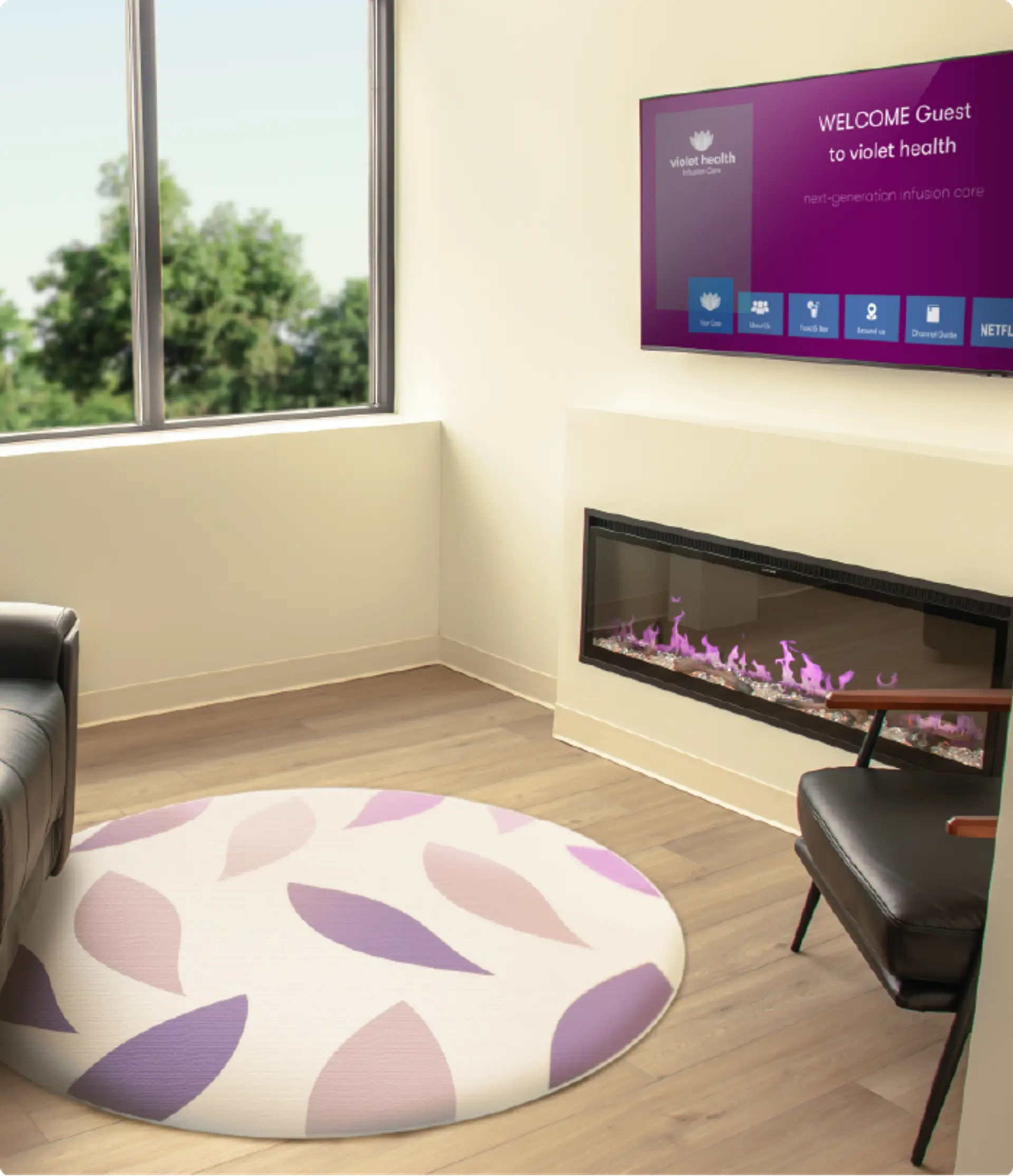
When you arrive at our Violet Health location, you'll settle into a private, welcoming space designed with your comfort and peace of mind in mind. These visits usually run longer than single-drug visits, because PERJETA® is given alongside trastuzumab and often chemotherapy on the same day. Before and during your intravenous infusion, our experienced team will:
- Review your current health status and any new symptoms, including shortness of breath, a new or worsening cough, swelling in your legs, ankles, or face, rapid weight gain, palpitations, or dizziness
- Check your vital signs
- Ask specifically about diarrhea, which is the most common side effect of this regimen and the easiest to manage when it is caught early
- Confirm that your heart function monitoring is current
- Place your IV using gentle, practiced technique
- Administer your PERJETA® infusion, then observe you before your other medicines are given
- Monitor you closely for infusion-related reactions, which are most common with the first dose
- Protect your privacy and comfort throughout the visit
Your dose is prepared with care. PERJETA® is diluted in 0.45% or 0.9% sodium chloride, never in dextrose, and nothing else is mixed into the bag.
Order matters on combination days. PERJETA® and trastuzumab are given one after the other and can go in either order, and any taxane chemotherapy such as docetaxel or paclitaxel is given after both antibodies. If your plan includes an anthracycline, the antibodies begin only after that portion of chemotherapy is finished.
Your first visit includes 60 minutes of infusion time, followed by a 30 to 60 minute observation period before trastuzumab or chemotherapy is started. Later visits are shorter, usually 30 to 60 minutes of infusion with at least 30 minutes of observation afterward. Everyone follows the same three-week rhythm, and how many cycles you receive depends on whether you are being treated before surgery, after surgery, or for metastatic disease.
PERJETA® Side Effects
As with any medication, PERJETA® may cause side effects. Being informed helps you know what to watch for and when to contact your healthcare team. Across the clinical trials, where PERJETA® was given with trastuzumab and chemotherapy, the most common reactions were:
- Diarrhea, the standout in every study, reported by roughly two-thirds to three-quarters of patients
- Hair loss
- Nausea and vomiting
- Low white blood cell counts, including febrile neutropenia
- Fatigue and weakness
- Peripheral neuropathy, or numbness and tingling in the hands and feet
- Mouth sores and mucosal inflammation
- Constipation
- Rash, dry skin, itching, and nail changes
- Anemia
- Muscle and joint pain
- Headache
- Changes in the way food tastes, and decreased appetite
- Fever
- Nosebleeds
- Watery eyes
- Trouble sleeping and hot flashes
Much of that burden comes from the chemotherapy given alongside PERJETA® rather than from PERJETA® itself. Once chemotherapy ends and you continue on PERJETA® and trastuzumab alone, the picture narrows considerably. In the trials, the reactions that persisted in that phase were mostly diarrhea, joint pain, hot flashes, rash, headache, and fatigue.
Diarrhea deserves its own note. Tell us at the first sign rather than waiting, because early treatment with loperamide, fluids, and electrolyte replacement usually keeps it manageable. In the adjuvant trial, the median episode lasted about eight days, and hospitalization for it was uncommon at 2.4%. Diarrhea was more frequent with non-anthracycline regimens than with anthracycline-based ones, and it eased for most patients once chemotherapy was finished.
Boxed Warning: PERJETA® carries the FDA's strongest warning for two serious risks. Please alert our clinical staff or seek medical attention immediately if you notice any of the symptoms below.
- Left ventricular dysfunction: PERJETA® can cause a drop in your left ventricular ejection fraction and congestive heart failure, including cases without symptoms that show up only on imaging. The risk is higher if you have had anthracycline chemotherapy or prior radiation to the chest. Report new or worsening shortness of breath, a persistent cough, swelling in your ankles, legs, or face, palpitations, weight gain of more than five pounds in 24 hours, dizziness, or fainting.
- Embryo-fetal toxicity: Exposure during pregnancy, or within seven months before conception, can cause embryo-fetal death and birth defects, including low amniotic fluid that can lead to underdeveloped lungs, skeletal abnormalities, and newborn death.
Other serious risks are less common, and they are worth knowing about so you can speak up early:
- Infusion-related reactions, including rare fatal events. On the first day, when PERJETA® is given by itself, reactions occurred in about 13% of patients, most often fever, chills, fatigue, headache, and vomiting. When all the drugs are given on the same day, the rate was about 21%. Report trouble breathing, wheezing, throat tightness, chest pain, or feeling faint
- Hypersensitivity reactions and anaphylaxis, including angioedema, or swelling of the face, lips, tongue, or throat. PERJETA® is not given to anyone with a known hypersensitivity to pertuzumab or any of its ingredients
- Febrile neutropenia and serious infection, including fever, chills, or sore throat while your white blood cell count is low
- Severe or persistent diarrhea leading to dehydration, with lightheadedness or decreased urination
Heart monitoring: You have an echocardiogram or MUGA scan before your first dose, then roughly every 12 weeks during treatment, with one check during the neoadjuvant phase if you are being treated before surgery. Starting treatment generally requires an LVEF of at least 55% in early breast cancer, or at least 50% for metastatic disease, and an LVEF of at least 50% after any anthracycline portion is complete.
If your LVEF declines meaningfully, PERJETA® and trastuzumab are both held for at least three weeks and then rechecked. Treatment resumes if your heart function has recovered. If it has not improved, or has dropped further, your team will strongly consider stopping both drugs permanently. PERJETA® has not been studied in patients who start with an LVEF below 50%, who have a history of congestive heart failure, whose LVEF fell below 50% during earlier trastuzumab therapy, or who have uncontrolled hypertension, a recent heart attack, a serious arrhythmia needing treatment, or cumulative prior anthracycline exposure above 360 mg/m² of doxorubicin or its equivalent.
Pregnancy and breastfeeding: Your pregnancy status is verified before your first dose. Use effective contraception during treatment and for seven months after your last dose of PERJETA® given with trastuzumab, and do not breastfeed during that same window. Exposure within seven months before conception can also harm a fetus. If you become pregnant during treatment or within seven months of your last dose, tell your care team right away so your pregnancy can be monitored for low amniotic fluid. The manufacturer runs a pregnancy pharmacovigilance program that follows these exposures.
PERJETA® Infusion Therapy at Violet Health
Your comfort during PERJETA® infusion therapy at Violet Health is our priority. Our patients enjoy walk-up parking, complimentary entertainment and snacks, and a team of highly trained providers during each treatment. Plus, Violet Health's evening and weekend hours and convenient city and rural locations make it easier to schedule your appointments.
Meet our Infusion Specialists

Jalal Thwainey M.D.
Medical Director

Emilie Wojcik, N.P.
Director of Clinical Services
For Provider
Simplify patient referrals and offer advanced treatment options with our infusion partnership program.
For Patient
There may be a better way to manage your condition – explore infusion therapy.